 |
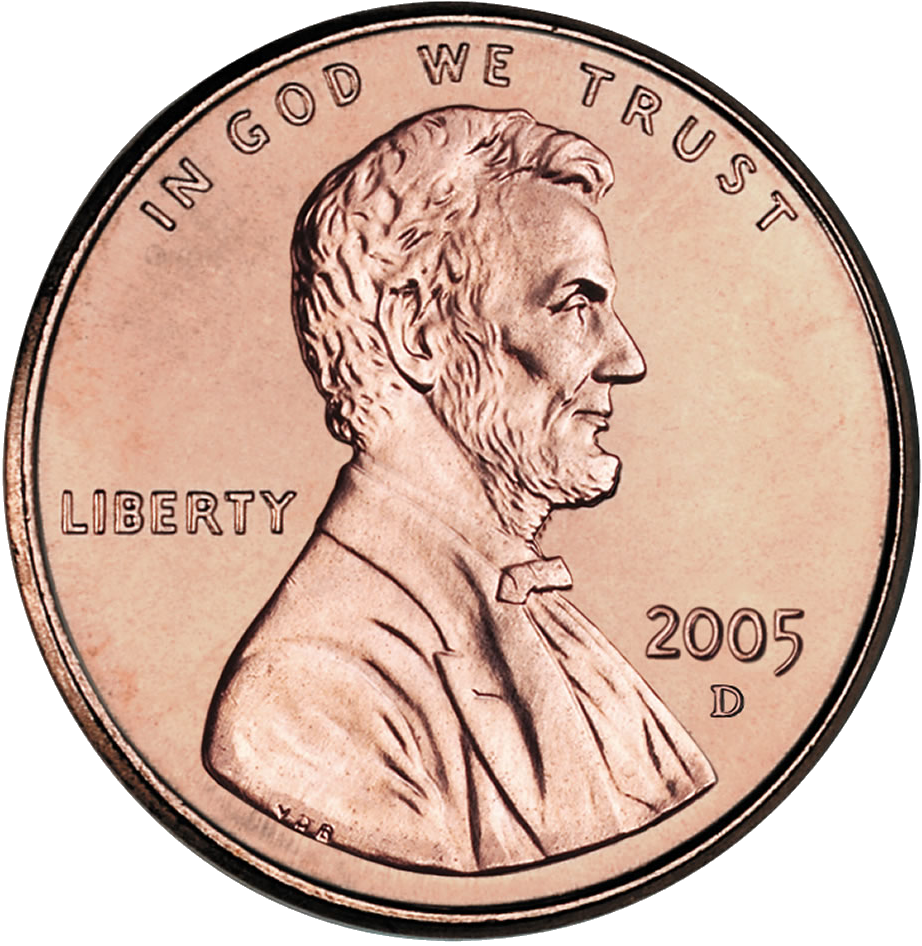
| Abraham Lincoln on the American penny |
In the United States of America, the currency used is in the form of coins and dollar bills. The lowest amount of money in circulation is the penny, which is technically worth one one-hundredth of a dollar. In reality, however, the metal used to make the penny is worth more than twice that amount. In 2013, the cost it took the United States Mint to manufacture one penny is 2.41 cents, which means the government spent nearly $169 million in just 2013 to put $70 million in pennies into circulation. Robert M. Whaples, professor of economics at Wake Forest University and an expert on the history of the US economy, also estimated that the United States loses roughly $900 million a year on penny production and handling. It is clear, to taxpayers, that this is not only a huge loss of money, but also easily avoidable. In fact, in 1972, although a penny was worth what a nickel is worth today, the economy managed very well without a coin that is worth the equivalent of a penny today. This shows that a monetary value that is one one-hundredth of a dollar is totally unnecessary for a successful economy to work. And also, as Professor Whaples said, “There's this cash drawer sitting there with four slots for coins. Currently, there's (a slot for) a penny, a nickel, a dime and a quarter. If you freed up that penny space, there would be an open place and, naturally, we would move to using a $1 coin. The Federal Reserve has estimated that replacing paper $1 bills with more durable $1 coins could save $500 million a year." Taking away pennies and dollar bills and replacing them with dollar coins could save our nation as a whole nearly a billion dollars. If solving this problem is as easy as removing a few coins from circulation, why has it garnered so little attention from the members of Congress who are so busily looking for ways to pay off our national debt?
Money aside, there is also another benefit of losing the penny. The National Association of Convenience Stores and the Walgreens drugstore chain have estimated that handling pennies adds 2 to 2.5 seconds per cash transaction. Assume that the average citizen makes one such transaction every day, therefore wasting about 730 seconds a year. The median worker earns just over $36,000 a year, or about 0.5 cents per second, so working with pennies costs him $3.65 annually. This means that nationally, while we’re fiddling with these near-worthless flat discs of bacteria, we’re losing billions a year. What part of keeping the penny makes sense at all? In July of 2006, Rep. Jim Kolbe (R-Ariz.) decided to take action on this issue by introducing a bill that would get rid of the penny. He revealed that in the first half of the year 2006 alone, the U.S. government minted 4.8 billion pennies, and since it cost nearly 3.5 cents to make and distribute each penny, that robbed taxpayers of $115 million. However, even with such strong evidence and practical sense, Rep. Kolbe could not pass this bill, and the penny remained.
Consumers may worry that rounding up on costs could potentially lose them a few dollars a year. This has been proven false by many experimental studies, including one which looked at hundreds of thousands of transactions, and found that after all other taxes and fees were added, rounding prices to the nearest nickel actually led to a net gain for customers. Moreover, we have a precedent to follow by. Canada, along with many other nations, got rid of the penny, and saved billions of dollars. A study conducted by the Bank of Canada ahead of the decision to retire the penny concluded that there would be no significant impact on inflation. About a year into Canada's penniless phase, this has proven true, much like it has in other countries.
The US also has some experience with eliminating defunct currency. In 1857, it stopped minting the half-cent coin after Congress realized that its purchasing power (the equivalent of around 11 cents today) and cost of production had made it impractical. This move led to no immediate or long-term effects on the value of U.S. currency. Furthermore, some Americans are already used to a life without pennies. U.S. military bases abroad gave up on the coins around 30 years ago. The Department of Defense told the Los Angeles Times in 2008 that they were simply "too heavy and are not cost-effective to ship." Why aren’t we following suit? The penny costs too much, wastes time and energy, and has no functional value to our society. Is sentimentality worth the price of all that?
The only cost to bring pennies out of circulation is our sentimental attachment. We have seen other countries do the very same thing, with great results, yet we are too stubborn and affectionate of these outdated coins to let go. The great thing about America is that we have so many smart people able to convey a situation and find the easiest, most efficient solution. But the less great thing is that politicians are under so much pressure to be popular that they don’t always do the right thing. Along with our sharp consumers and healthy economy, we could do great things with the loss of our unnecessary coins.
For more information visit the Vlogbrothers at Pennies and Nickels, or read this article from the Huffington Post: Can We All Just Agree That Pennies Are Stupid And Need To Be Retired? and this article from mint.com: Should the U.S. Mint Ditch the Penny?
 |
| The Canadian penny, now out of circulation |
What about you, Nargles and readers? What do you think? Should we get rid of pennies (and possibly nickels) and replace them with dollar bills?
- Quibbles 8/14/14
